Customers no longer want to fill out long forms, wait on hold, or dig through FAQs. They want to ask a question in plain language and get a helpful answer right away. That is exactly where conversational solutions shine.
From AI chatbots and virtual agents to smart voice assistants and messaging automation, conversational solutions turn static, one-way touchpoints into natural, two-way conversations that feel human, fast, and highly relevant. By transforming call center operations with AI, businesses can enhance efficiency and customer experience, making an AI Call Center a game-changer for modern support.
This guide walks you through what conversational solutions are, why they matter now, and how you can use them to boost satisfaction, reduce costs, and unlock new revenue.
Beyond simply answering questions, reliable cloud platforms for enterprises allow organizations to manage large volumes of customer interactions with speed and reliability. Modern tools now combine artificial intelligence with supercomputers for advanced real-time processing, giving companies the ability to predict customer needs before they even ask.
Marketers and service teams can also benefit from customer engagement methods that really work, ensuring that each interaction is meaningful, timely, and personalized. When integrated with conversational AI, these approaches create a seamless journey where users feel understood rather than treated like a number.
For brands looking to enhance online visibility, practical marketing tips for better service provide actionable steps that align with AI-driven support. These guides show how combining human creativity with automated solutions can generate loyal customers and consistent growth.
Financial decision-makers are not left behind; essential finance resources for businesses offer insights on optimizing budgets and maximizing ROI from AI call centers. These resources help organizations invest wisely in technology while maintaining the personal touch that customers expect.
Ultimately, implementing conversational solutions that integrate with multiple channels transforms not just customer service, but the entire business ecosystem. By connecting AI, marketing, analytics, and finance, companies can build smarter, more empathetic interactions that boost satisfaction, reduce churn, and create new revenue opportunities.
Top 10 Contact Center Solutions for Modern Businesses
Choosing the right contact center solution is crucial for businesses aiming to deliver seamless customer experiences. Conversational solutions powered by AI can transform traditional support into interactive, efficient, and personalized experiences. Here’s a look at the top 10 solutions, with Bright Pattern leading the way.
1. Bright Pattern – AI Contact Center Solutions
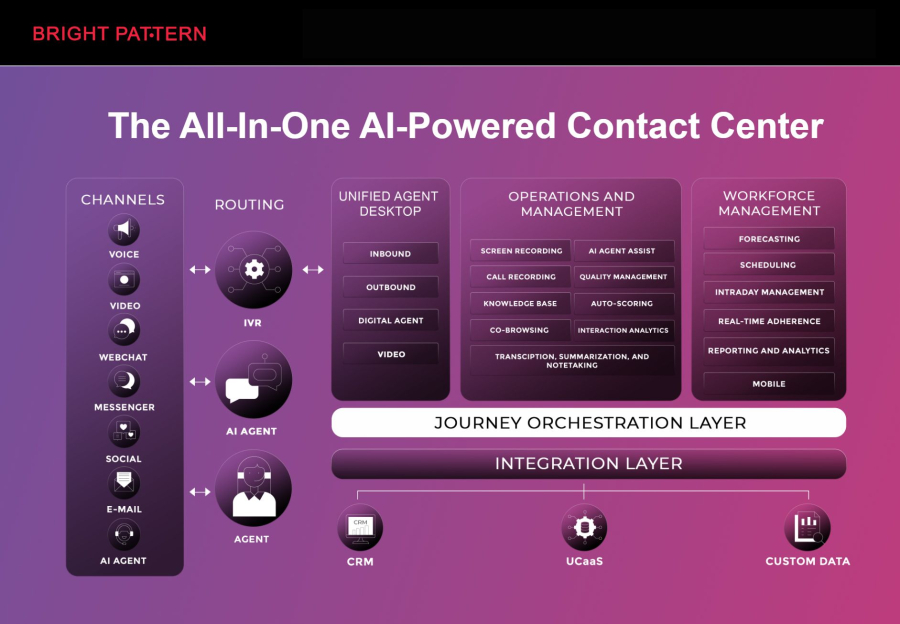
Bright Pattern offers a comprehensive platform for businesses to implement AI-driven conversational solutions across multiple channels. It enables organizations to provide personalized, responsive customer interactions while reducing operational costs and improving agent productivity.
Key features of Bright Pattern include:
- Omnichannel support for voice, chat, email, and messaging apps
- AI-powered chatbots and virtual agents for automated support
- Smart routing to ensure customers reach the right agent quickly
- Real-time analytics to monitor agent performance and customer satisfaction
- Easy integration with CRM and marketing platforms
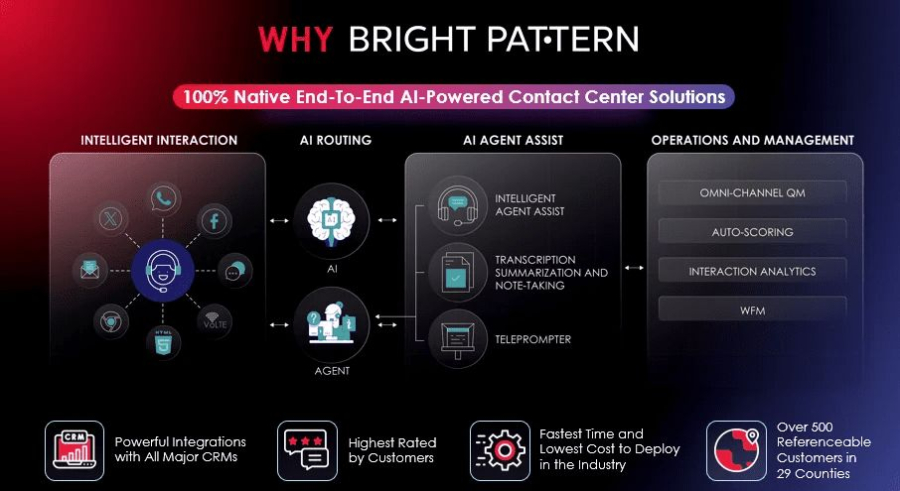
Bright Pattern’s conversational solutions are designed to streamline call center operations, improve customer engagement, and provide actionable insights that drive business growth.
2. Five9 – Cloud Contact Center Software
Five9 offers cloud-based call center solutions with AI capabilities that enhance agent efficiency and customer interactions. Its platform supports automated workflows, predictive dialing, and analytics for better decision-making.
3. Genesys – Omnichannel Customer Experience
Genesys provides a scalable contact center solution that integrates AI and machine learning to optimize customer journeys. It supports voice, chat, email, and social media interactions.
4. NICE inContact – Cloud Contact Center Platform
NICE inContact offers AI-driven contact center software that enables omnichannel support, workforce optimization, and detailed analytics to enhance customer satisfaction.
5. RingCentral – Unified Contact Center
RingCentral delivers a unified solution combining voice, messaging, and video with AI-powered tools for call routing, analytics, and customer insights.
6. Talkdesk – Intelligent Cloud Contact Center
Talkdesk provides AI-enhanced conversational solutions that help automate routine tasks, improve call handling, and provide actionable data for better service quality.
7. 8x8 – Cloud Contact Center Solution
8x8 focuses on providing scalable cloud-based contact center solutions with AI features, omnichannel support, and performance analytics for customer engagement.
8. Avaya – AI-Enhanced Call Center
Avaya’s contact center solutions integrate AI to streamline workflows, enhance agent productivity, and deliver a consistent omnichannel customer experience.
9. Cisco – Customer Contact Solutions
Cisco offers advanced call center solutions with AI integration, analytics, and unified communications to improve efficiency and customer satisfaction.
10. Zendesk – Customer Service Platform
Zendesk provides a flexible platform for managing customer interactions across multiple channels, with AI-powered tools for automation and improved conversational solutions
What Are Conversational Solutions?
Conversational solutionsare technologies that let people interact with your business using natural language, instead of clicks, forms, or complex menus. They understand what a user says or types, decide on the best response, and reply in a way that feels like a real conversation.
They are usually powered by technologies such as:
- Natural language understandingto interpret what the user actually means
- Dialogue managementto decide what the system should say or do next
- Integrations with your systemssuch as CRM, support tools, or e commerce platforms
Instead of forcing users to adapt to your interfaces, conversational solutions adapt to how people naturally communicate.
Why Conversational Solutions Are Taking Off Now
A few powerful trends have made conversational solutions one of the fastest growing areas in customer experience and automation.
- Customers expect instant answersacross chat, messaging, and voice, at any hour of the day.
- AI accuracy has improved dramaticallyso systems can understand complex queries and respond in context.
- Businesses need to scale support and saleswithout endlessly expanding headcount and costs.
- Messaging apps and live chatare now mainstream, making conversation the default way people interact online.
Conversational solutions sit right at the intersection of these trends. They let you deliver fast, personal, always on interactions without burning out your human teams.
The Core Benefits of Conversational Solutions
When implemented thoughtfully, conversational solutions deliver a powerful mix of customer facing and internal benefits.
1. Always on, instant support
A well designed virtual agent or chatbot can handle common questions and simple tasks 24 hours a day, 7 days a week. No queues, no opening hours, no frustration.
- Customers feel taken care of even outside business hours.
- Response times drop from minutes to seconds.
- Urgent issues can be triaged and prioritized for human agents.
2. Happier customers and higher satisfaction
People remember how easy or painful it was to get help. Conversational solutions reduce friction at every step of the journey.
- They offersimple, natural language interactionsinstead of complex menus.
- They canpersonalize responsesbased on customer history or preferences.
- They provideconsistent service qualityregardless of who is on shift.
All of this shows up clearly in metrics like customer satisfaction scores and net promoter scores.
3. Lower service costs without cutting quality
Every question that a conversational solution resolves is one less ticket or call for your human team to handle. Over time, this adds up to substantial cost savings.
- Automate repetitive, low complexity questions.
- Free human agents to focus on high value, emotionally sensitive issues.
- Handle peak demand without hiring a large temporary workforce.
The result is a leaner, more efficient operation that still feels premium from a customer point of view.
4. Increased revenue and conversion
Conversational solutions are not just for support. They also guide prospects through buying decisions, recover abandoned carts, and surface relevant offers at the perfect time.
- Answer product questions in the moment of intent.
- Recommend add ons or upgrades based on past behavior.
- Qualify leads and route hot prospects directly to sales.
Used across the funnel, they turn conversations into conversions.
5. Rich insight from every interaction
Every chat, message, or voice interaction is a data point. Over time, you can learn exactly what customers ask, where they get stuck, and what they care about most.
- Spot gaps in your knowledge base or product information.
- Discover new ideas for features, content, and offers.
- Fine tune your messaging and support scripts using real language from real customers.
Conversational solutions become a continuous listening channel that makes your entire organization smarter.
Types of Conversational Solutions
Modern conversational ecosystems are made up of several building blocks. You can start small with one or two, then expand as you learn what works.
1. Chatbots on web and mobile
These are the chat bubbles customers see on your site or app. They can greet visitors, answer FAQs, help with navigation, and support basic transactions such as booking or order tracking.
2. Messaging automation
Messaging channels such as SMS and popular chat apps are ideal for conversational experiences. Automated flows in these channels can handle tasks such as:
- Sending proactive order updates and reminders.
- Collecting feedback right after a purchase or interaction.
- Helping customers complete forms or onboarding steps in a simple, conversational way.
3. Voice assistants and voice bots
Voice based conversational solutions let people speak naturally instead of typing or tapping. Common examples include:
- Voice driven self service in contact centers.
- Smart speaker skills for quick information and actions.
- In app voice assistants that let people control features hands free.
4. AI assisted live chat
Here, human agents stay in the loop but are supported by AI. The system can suggest responses, surface relevant knowledge, summarize past interactions, and automate follow up tasks.
This hybrid model combines the empathy and judgment of humans with the speed and consistency of automation.
Where Conversational Solutions Deliver the Biggest Impact
Almost every function in a business can benefit from conversational solutions, but a few areas see especially strong results.
Customer support and service
- Answer frequently asked questions around orders, billing, and policies.
- Guide customers through troubleshooting step by step.
- Automate simple changes such as address updates or password resets.
Sales and lead generation
- Qualify leads by asking targeted questions.
- Book demos or appointments without email back and forth.
- Recommend packages or pricing based on customer needs.
Marketing and engagement
- Deliver interactive quizzes and product finders in chat.
- Run conversational campaigns instead of static forms.
- Send follow up sequences that feel like real check ins, not generic blasts.
Operations and internal support
- Provide employees with a self service help desk for IT or HR questions.
- Automate common internal requests, such as access or approvals.
- Onboard new team members with guided, conversational checklists.
Designing Conversational Solutions That People Love
The technology is important, but the experience is what people feel. A successful conversational solution needs thoughtful design just like a successful product or website.
Start with real customer journeys
Instead of trying to automate everything at once, map out a few high impact journeys.
- Identify the top questions customers ask today.
- Spot bottlenecks where people get frustrated or drop off.
- Choose one or two journeys where a faster, simpler conversation would make a clear difference.
Give your assistant a clear role and personality
Customers should immediately understand who or what they are talking to and what it can help with.
- Set expectations by introducing it as a virtual assistant or automated agent.
- Use a friendly, consistent tone that fits your brand.
- Keep language clear and simple, especially around instructions.
Design for natural, flexible dialogue
Real conversations are not perfectly linear. People change their minds, go off topic, or skip steps. Effective conversational solutions handle this gracefully.
- Allow multiple ways to ask for the same thing.
- Offer quick reply suggestions to guide the user.
- Confirm important details before finalizing actions.
Make handoff to humans feel seamless
One of the strengths of conversational solutions is knowing when to hand off to a human, not pretending to handle everything.
- Trigger human handoff for sensitive topics or high value opportunities.
- Pass context so the agent sees the full conversation history.
- Let customers know clearly when a person is taking over.
Practical Steps to Implement Conversational Solutions
You do not need a huge digital transformation program to get started. A focused, step by step approach works best.
Step 1: Clarify your goals
Decide what success looks like before you think about tools or channels.
- Do you want to reduce support volume or improve first response times.
- Are you focused on lead generation, sales, or post purchase care.
- Which metrics matter most, such as resolution rate, satisfaction, or revenue.
Step 2: Choose your first use cases
Pick a few use cases that are:
- High volume or high cost today.
- Relatively structured, such as order tracking or appointment booking.
- Low risk if the experience is not perfect on day one.
Step 3: Build, test, and iterate
Start with a minimum viable experience, then improve it based on real conversations.
- Launch to a small segment or a limited channel first.
- Monitor where users drop off or ask to speak to a person.
- Refine wording, flows, and training data continuously.
Step 4: Integrate with your existing systems
The more your conversational solution knows, the more helpful it can be.
- Connect it to your customer database for personalized experiences.
- Integrate with order, booking, or ticketing systems to enable real actions.
- Feed interaction data into analytics and reporting tools.
Step 5: Scale success across channels
Once your first scenarios are working well, you can extend them.
- Reuse proven conversation flows across web chat, messaging, and voice.
- Add new intents and tasks based on customer demand.
- Expand from customer facing use cases into internal operations.
Key Metrics to Track for Conversational Solutions
To keep your initiative focused and growing, track both business and experience metrics.
|
Metric |
What it tells you |
|
Containment or automation rate |
How many interactions are fully handled without human help. |
|
Average response time |
How quickly users get helpful replies. |
|
Resolution rate |
How often the conversation actually solves the user problem. |
|
Customer satisfaction |
How people feel about the interaction overall. |
|
Escalation rate |
How often conversations need human agents and why. |
|
Cost per interaction |
How much you save compared to traditional channels. |
Overcoming Common Concerns
While the benefits are compelling, teams sometimes hesitate to adopt conversational solutions. The good news is that most concerns can be addressed with smart design and clear communication.
Concern: Customers will hate talking to a bot
Customers do not dislike automation. They dislike unhelpful experiences. When conversational solutions are transparent, fast, and genuinely useful, people embrace them.
- Be upfront that they are interacting with an automated assistant.
- Provide clear options to reach a human when needed.
- Continuously improve based on feedback and real interactions.
Concern: It will be complex and time consuming to set up
You can start small and grow over time. Many teams launch a focused solution in weeks, not months, by narrowing the initial scope and working in short, iterative cycles.
Concern: Automation will replace human agents
In practice, conversational solutions free human agents from repetitive work so they can focus on complex cases and meaningful customer relationships. The result is a more engaging, higher value role for your team.
The Future of Conversational Solutions
The next wave of conversational solutions will feel even more natural, personal, and proactive.
- More context awarenessso assistants remember history and adjust to each user.
- Richer, multimodal experiencesthat blend text, voice, and visual elements.
- Deeper integration across the customer journeyfrom discovery to advocacy.
As these capabilities mature, your conversational layer will become the front door to your business, the way most customers prefer to interact day to day.
Bringing It All Together
Conversational solutions are far more than chatbots on a website. They are a new way of designing your customer and employee experiences around natural, helpful dialogue.
By starting with clear goals, focusing on a few high impact journeys, and iterating based on real conversations, you can unlock faster support, happier customers, lower costs, and new revenue opportunities.
Most importantly, you transform every interaction from a transaction into a real conversation, one that builds trust, loyalty, and long term growth for your business.
